← Back to projects

El Berrueco · Sierra de Madrid · Residential · Built

La Pajarilla

Life in the shade of the holm oaks.

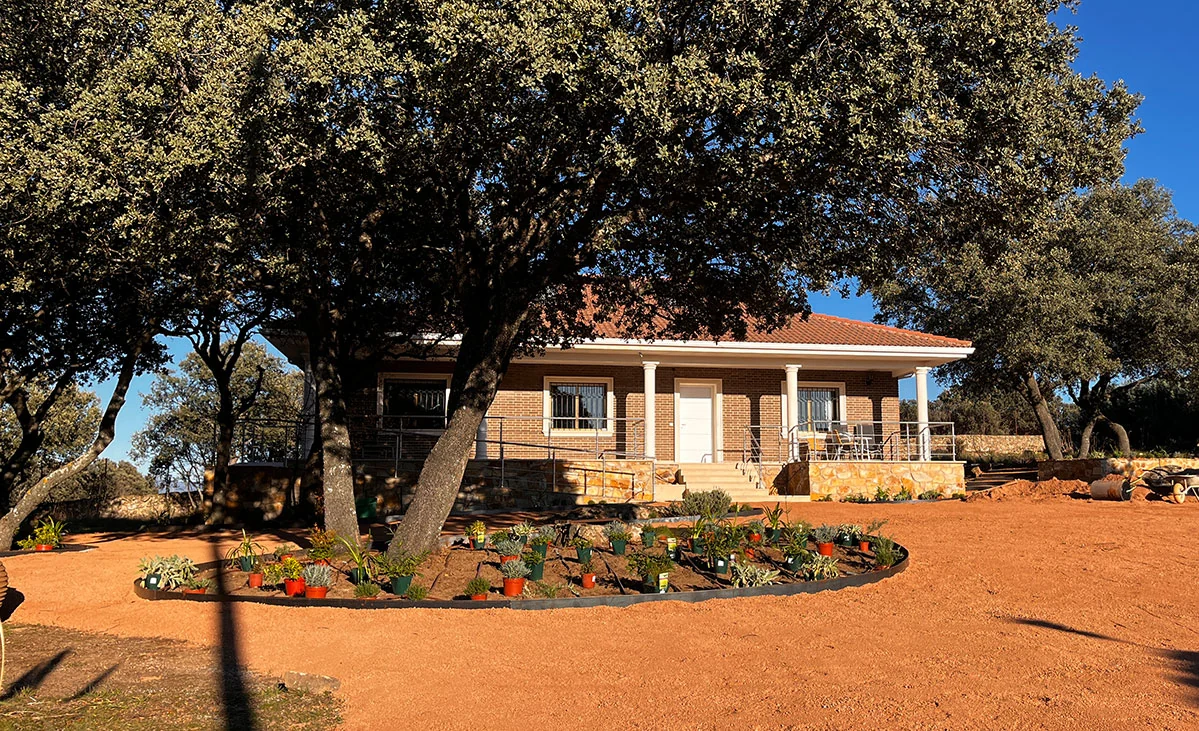
Naturalistic garden beneath holm oaks at La Pajarilla in the Madrid mountains

The gesture

Intervene less, belong more.

In the Madrid mountains, the landscape already holds a rhythm of its own. Holm oaks, landform and seasons did not ask for a dramatic transformation, but for a gentler way of inhabiting what was already there.

Carefully placed paths, water and seating areas make the garden comfortable to use. Native species and Mediterranean planting create a resilient naturalistic garden with low water use, closely bound to its surroundings.

The landscape was already there

At La Pajarilla, the first decision was to recognise that the place did not need to be invented anew. Holm oaks, rock, slope and the light of the Madrid mountains already formed a landscape with identity. Walking the site revealed how water moved, where shade fell and which views should remain. The naturalistic garden therefore appears as a continuation of its surroundings: close to the house, yet still part of the open mountain landscape.

Naturalistic planting beneath the holm oaks

Conditions beneath a holm oak vary throughout the day. Shade moves across the ground, while the tree’s roots compete with other plants for water. Designing beneath its canopy means understanding those demands and avoiding solutions that could compromise the existing trees. Plant selection begins with native or adapted species able to live with dryness, partial shade and the temperature contrasts of the Madrid mountains.

Naturalistic planting is arranged as a community, not a collection of isolated specimens. Continuity, repetition and variation allow the garden to be read as a whole rather than depend only on flowers. Texture, form and tone sustain interest throughout the year. The planting accompanies the holm oaks without imitating or competing with them, creating an intermediate layer where life can find shelter.

A Mediterranean garden that understands water

The Mediterranean climate combines long dry periods with intense rainfall. Landform, soil permeability and plants with compatible needs therefore belong to one strategy. Irrigation is concentrated where it is needed and can be reduced as planting becomes established. A low-water garden can remain complex, changing and full of life when it responds to place.

Maintaining a natural character

Caring for a naturalistic garden asks for knowledge more than intensity. It means distinguishing between a plant that can join the community and one that threatens its balance; knowing when to cut while preserving food or structure; and observing how each area responds before intervening. Work is concentrated at particular moments and follows the garden’s real development.

We can accompany this process after construction or pass on its principles through a maintenance guide. In this way, care preserves the project’s intention even when undertaken by another team. Here, the return on considered design becomes clear: fewer corrections, more precise water use and planting that gains stability with the years. Care allows La Pajarilla to develop while retaining its connection to the surrounding mountain landscape.

Beauty can be a form of respect.

Let’s talk about your garden ↗